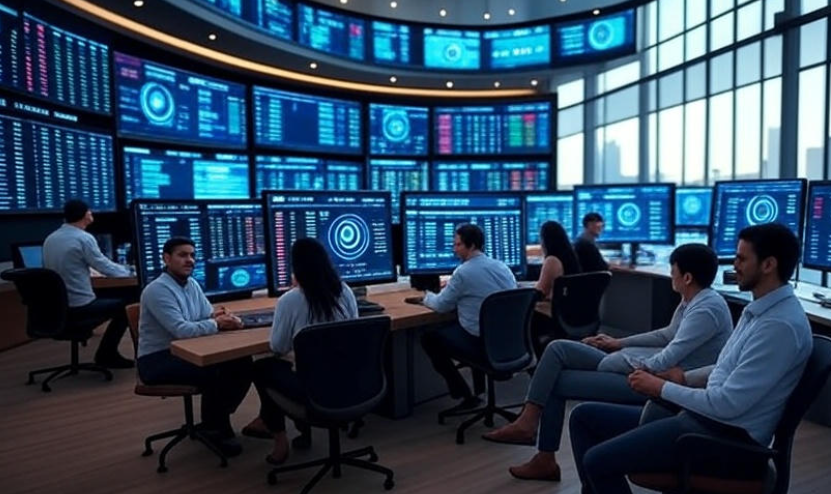

The stock market is like a giant ocean 🌊. Every day, millions of people and companies jump in, hoping to catch the right wave. But the ocean is never steady—it rises, falls, and sometimes even crashes without warning. This unpredictability is what makes stock trading both exciting and risky. Over the years, investors have tried countless methods to guess where the market is going. Today, one of the most powerful tools in this mission is Artificial Intelligence (AI).
AI is not just a fancy buzzword anymore. It is actively being used to predict stock market trends, analyze data, and even help investors make smarter decisions. But how exactly does AI manage to look into this complex financial jungle and give predictions? Let’s break it down in simple words.
Why AI in stock market predictions matters
The stock market generates enormous amounts of data every second—prices, news, social media opinions, company earnings, global events, and more. A human trader can’t possibly read and analyze all of this at once. But AI can.
AI doesn’t get tired, it doesn’t panic, and it doesn’t miss details hidden in the data. By using machine learning and other advanced models, AI can scan through thousands of data points and try to figure out patterns. These patterns often show whether a stock might go up 📈 or down 📉 in the near future.
How AI works in stock predictions
To make it simple, here’s the step-by-step process:
-
Collecting Data – AI systems gather information from stock prices, global news, social media platforms like Twitter, company balance sheets, and even government policies.
-
Cleaning Data – The raw data is messy. AI removes errors, duplicates, and irrelevant noise.
-
Analyzing Patterns – AI models are trained on past market movements. They learn what signals led to a rise or fall in stock prices.
-
Predicting Trends – After training, the AI tries to predict future price movements based on current market signals.
-
Continuous Learning – AI keeps improving. The more data it gets, the smarter it becomes over time.
Different AI techniques used in stock market predictions
AI isn’t one single tool. It’s made up of different methods and technologies. Some of the most common ones used in stock market predictions are:
-
Machine Learning (ML) – Algorithms that learn from past data and improve predictions over time.
-
Natural Language Processing (NLP) – AI reads news articles, social media posts, and financial reports to understand the market’s mood.
-
Deep Learning – Complex models like neural networks that mimic how the human brain works. They are great at identifying hidden patterns.
-
Sentiment Analysis – This checks whether public opinion is positive 😊, negative 😡, or neutral 😐 about a stock or company.
-
Reinforcement Learning – AI learns from trial and error, like a trader who tests different strategies and improves over time.
Table: AI vs Human in stock market predictions
| Factor | AI Predictions 🤖 | Human Traders 👨💼 |
|---|---|---|
| Speed | Processes millions of data in seconds | Limited, slower |
| Emotions | None (logical decisions) | Emotional (fear, greed) |
| Data Handling | Handles big data easily | Struggles with too much data |
| Accuracy | Can improve with learning | Depends on experience |
| Adaptability | Learns continuously | Takes time to adapt |
Real-world uses of AI in stock market predictions
-
Hedge Funds and Investment Firms – Many hedge funds rely on AI to design trading strategies. They use algorithms that execute thousands of trades in microseconds.
-
Retail Trading Apps – Apps like Robinhood and eToro often use AI to give users suggestions on which stocks to buy or sell.
-
Fraud Detection – AI doesn’t just predict trends; it can also detect unusual activities that may point to insider trading or fraud.
-
Robo-Advisors – AI-based financial advisors provide personalized investment advice based on a user’s risk level.
The rewards of using AI in stock predictions
-
More Accuracy – AI can spot signals that humans usually miss.
-
Faster Decisions – No time wasted, AI reacts instantly.
-
Better Risk Management – By predicting possible downturns, AI helps investors protect their money.
-
Unbiased Choices – AI doesn’t get greedy or scared. It just follows logic.
The risks of using AI in stock predictions
Of course, AI isn’t perfect. Some of the risks include:
-
Overfitting – AI sometimes learns too much from past data, which doesn’t always predict the future.
-
Black Box Problem – Many AI models are too complex to understand, even for experts. Traders may not know why AI gave a certain prediction.
-
Market Shocks – Events like pandemics or wars can break predictions because AI didn’t see them coming.
-
Dependence on Data – If data is wrong or manipulated, AI predictions will also be wrong.
Is AI replacing human traders?
Not really. AI is more like a powerful assistant. It gives insights, but humans still make the final call. Experienced traders often use AI tools as part of their decision-making process rather than relying on them 100%.
Examples of AI success in stock market
-
JP Morgan’s LOXM system uses AI for trade execution and claims to be faster and more efficient than traditional systems.
-
Goldman Sachs has reduced its human trading team drastically because AI-based systems now handle much of the work.
-
Quant Funds like Renaissance Technologies heavily depend on AI and data models, often delivering higher returns than average funds.
Future of AI in stock market predictions
Looking ahead, AI will likely become even more advanced. With quantum computing on the rise, predictions might get faster and more precise. However, regulators will need to step in to ensure that markets remain fair and not fully controlled by machines.

FAQs
1. Can AI accurately predict stock prices?
AI can make educated predictions, but it cannot be 100% accurate. Unexpected world events can still disrupt predictions.
2. Is AI better than humans in stock trading?
AI is faster and better at handling big data, but humans still bring emotional intelligence and long-term vision that machines lack.
3. Can small investors use AI tools?
Yes, many trading apps now provide AI-driven insights that even beginners can use.
4. Is it risky to depend fully on AI?
Yes. AI should be used as a support tool, not the only decision-maker. Always combine AI predictions with human judgment.
5. Will AI completely control the stock market in the future?
Unlikely. While AI will play a huge role, regulations and human oversight will always remain important.
Final thoughts
AI in stock market predictions is like giving traders a superpower. It helps make sense of massive data, predicts possible trends, and provides a safety net against bad decisions. But at the same time, it comes with risks that should not be ignored.
In the end, the best approach is a balance: using AI’s speed and data-processing power ⚡ along with human experience and intuition. That’s the real winning formula for the stock market of the future.